Lumos Maxima – Real magic is reading, because reading unlocks the magic of imagination.
In the opening minutes of The Prisoner of Azkaban film, Harry is under his bedcovers casting the spell Lumos Maxima. A ball of light magically appears at the tip of his wand, illuminating a copy of Extreme Incantations which he is studying. Uncle Vernon’s footsteps creak on the landing and instantly the wand light goes out, Harry lies down and feigns sleep. Uncle Vernon looks in, sees Harry asleep and leaves. Harry tries again.
In the book, there is no spell. Harry is using an ordinary Muggle torch to study for an essay on the History of Magic. The Lumos Maxima spell was invented by the film’s director Alfonso Cuarón, a cinematic liberty that Harry Potter fans have argued about for years.But in both book and film, the premise is the same: to carry on doing something you cannot bear to stop, even at the risk of getting into trouble. And this is what has always stayed with me about that scene. It has nothing to do with underage wizarding law, it has to do with the fact that I have been Harry under the bedsheets and I suspect, if you are reading this, that so have you. And in all likelihood so has every adult who ever loved reading as a child.
On more occasions than I can count, I would be tucked up in bed still reading when one of my parents would come upstairs and tell me to go to sleep as it was getting late. My response was always the same: ‘Let me just finish this page.’ And as soon as they were gone, I would forget entirely and carry on reading.
What felt like hours later, but was probably no more than ten minutes, one of my parents would be back. The light would go out followed by an exasperated ‘Go to sleep!’ Sleep. I didn’t need sleep. Heroes didn’t need sleep. They pressed on through the quest with very little food and no rest whatsoever. I had a princess to rescue, a lost treasure to find, a monster to kill. Sleep was for people who did not have the responsibilities of a hero. I was that hero.
Very quickly I adapted in the way all heroes have to. I learned to dutifully put the book down turn the light out when told. But I could never go to sleep. The quest was waiting. As soon as the light under my bedroom door went out and the house fell quiet, out would come my torch. Deep under the duvet, breathing the warm stale air of my own little cave, I would open the book and dive back inside the story. The call to return was irresistible. It was not a choice I made, it was the complete conviction that the story needed me, the hero, to continue.
I have thought a lot about why that opening moment in the film – Harry, the covers, the light – has always stayed with me more vividly than the same scene in the book. In the novel, Harry uses a torch. He is us. He is every child who has ever read past bedtime by torch light. But in the film, Harry uses a spell. And whether the director intended it or not, the use of magic and light under the bed clothes reframes everything.
The light you read by in a duvet cave is not ordinary light. It is stolen light, conspiratorial light, a small secret act of defiance that transforms a cave into a kingdom. What is it that makes a child unable to put a particular book down? They are not just reluctant to put the book down, they are unable to. They are willing to risk getting into trouble, willing to sacrifice sleep and to lie there waiting for the house to go quiet so they can reopen the book and be back inside the adventure.
Why is that?
I think the answer is simpler than we might expect and also very important. A child lost in a book is not passively consuming entertainment. They are doing something active. They are building the world in their imagination, and living in the adventure. A screen provides the faces, renders the castle, manufactures the weather. None of it requires your imagination to exist. You can look away and look back and it is all still there, exactly as it was, but behind that screen it is somehow less alive than it is in your head. When a book is closed, the world is gone, and it will not come back until you start reading again, recreating the world with your mind.
Watching is observing. Reading is inhabiting.
When that experience disappears from a childhood, when the torch never comes out in the duvet cave, something is lost that no amount of content on a screen can replace. Late last year I was asked to present to forty eleven-year-old ‘reluctant readers’ at Midhurst Rother College in West Sussex. The school has around 1,200 students, drawn from villages and hamlets across four hundred square miles of countryside in and around the Sussex Downs.
For the session I workshopped ‘What is Story?’ During the hour we spent together, the children became deeply engaged. We talked about how everything is story from films to simply taking the bus to school or going shopping, and how, if they wanted to create their own stories, they had a secret weapon available to them at all times: the notebook.
Towards the end of the session I read a short passage Bert the Bat. I asked the children what kinds of things they would like to read about in the book. Their engagement was extraordinary. At the end of the hour I was mobbed for autographs, which is a first for me; I’m unpublished and write purely for pleasure. The children were desperate to know more about a book that is not even finished and for me, that was quite something. I was asked on the spot by the teacher to return and present to the entire year group (Year 7 UK, Grade 6 USA) for World Book Day, on the fifth of March 2026.
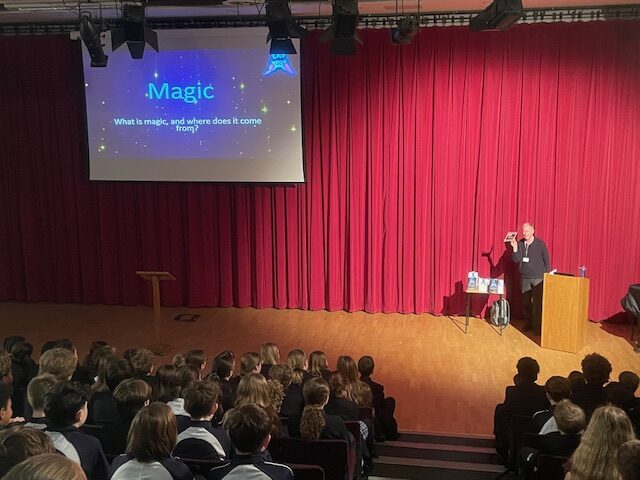
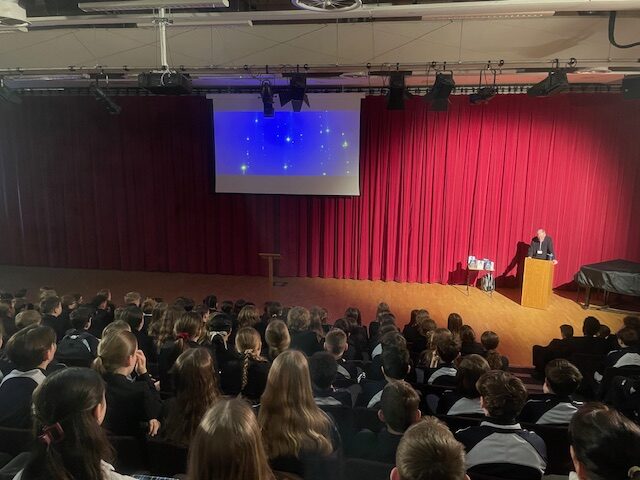
I did so, this time to present and read to over two hundred and twenty eleven-year-olds and five teachers.
No pressure!
This time my presentation was ‘What is Magic?’ I talked about how what we call magic has changed over the centuries. Six hundred years ago, if you had said that one day people would fly, they would have called it witchcraft, and you might well have been burned for saying it. Today we fly all the time. We do not even look up when a plane passes overhead. What was once unimaginable became engineering, and what was once sorcery became science.
The same story has played out again and again. Lightning captured in glass tubes – a light bulb.. A device in your pocket that lets you speak to someone on the other side of the world – a mobile phone. A surgeon who can stop a heart, repair it, and start it beating again – medicine. Every one of these things would have been called magic by the people who came before us. So I asked them: is there any magic left? Or has it all become science and there is no such thing as magic anymore?
And then I told them that I believe magic is real, and still very much alive. Real magic is reading, because reading unlocks the magic of imagination. Because Reading unlocks the magic of imagination.
Following this I read again from Bert the Bat. This time for twenty minutes and there was some concern from teachers that it would be too long to keep the attention of two hundred eleven year olds. The reading touched upon loss, danger, ancient mystery, responsibility and of course the type of magic that features in children’s fantasy. It was extraordinary. Two hundred eleven-year-olds not only sat in silence for the full twenty minutes -they leaned in, and after the reading hands started to go up everywhere to ask questions, but unfortunately I was out of time.
I have thought about that morning many times since. Not because it was a triumph, but because of what it proved. The hunger for reading is there. The willingness to be transported, to be frightened – to believe. Those children were not reluctant or lost to screens and computer games. They were waiting for someone to hand them a story and to trust them with it.
I am not a teacher, I’ve never even tried to get published, but in my own small way, in a forgotten corner of England I am trying to do what I can to keep the magic of reading alive.
The UK National Year of Reading 2026.